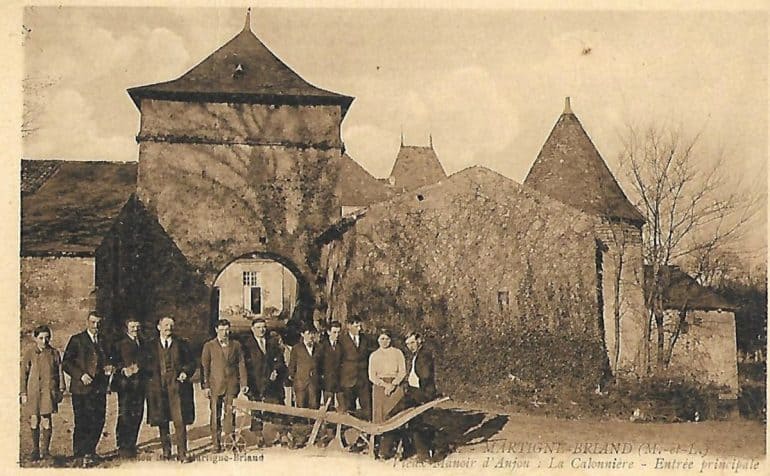
In the 17th century, the Patry de Calais family, a Norman house of chivalry, acquired Château de la Calonnière and planted a vineyard on the gentle slopes rolling down toward the Layon. Named Calaynnière, then Calouinnière, and later Domaine de la Calonnière over the centuries, the estate has passed through eras and owners, each cultivating this land with the same care.
1900
Paris, World's Fair. Château de la Calonnière wins the gold medal in the Coteaux du Layon category — an honour that establishes this schist terroir among the great appellations of the Loire.
1967
René Teurquetil and his brother take over the estate. They renovate the château and restore the gardens to their original character. They modernise the winery, renovate the harvesters' building, and plant new vines. René Teurquetil will later ensure the estate's continuity alone, over the years.
2021
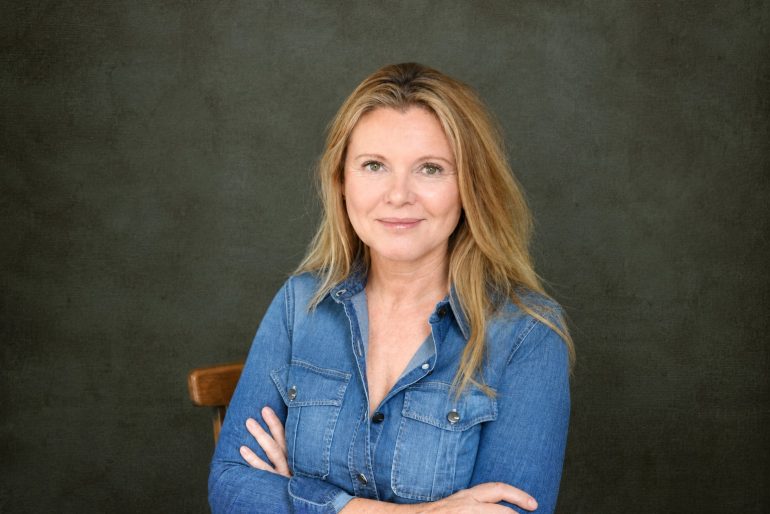
Catherine Teurquetil de Clermont-Tonnerre, who grew up among the vines with her brothers, takes over the family estate. Her ambition: to produce exceptional wines with real character, true to their terroir. Raising the bar even further, she begins the transition to organic farming, reduces yields, continues modernising the winery, and pursues the acquisition of exceptional plots in Bonnezeaux.
anjou noir, a unique terroir
Martigné-Briand holds a singular position within the vineyard region, halfway between the Saumurois and Savennières, right at the heart of the Coteaux du Layon. It is here, along the geological fault line of the Layon, that the Château de la Calonnière's 25 hectares of vines extend across the estate's 50 hectares.
The subsoil is a blend of schist and sandstone, characteristic of Anjou Noir. The schist retains heat, encourages milder nights, and limits water stress. The sandstone gives fruity red wines, and floral, supple white wines. Two rocks, two expressions, one shared mineral coherence.
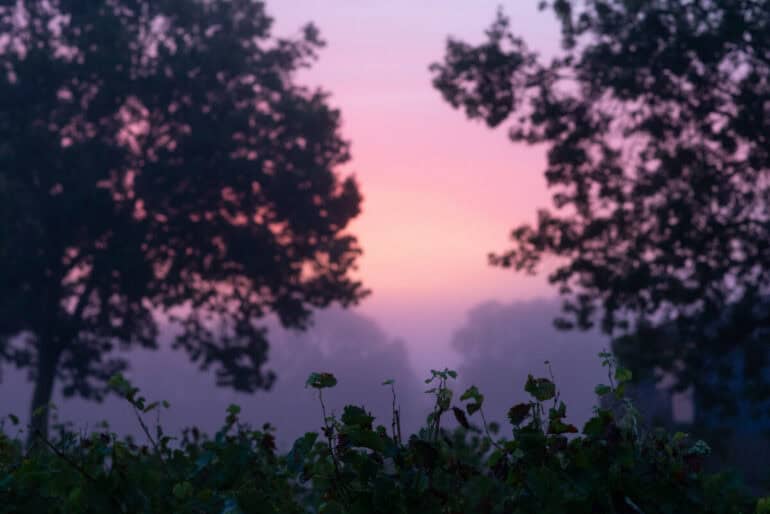
The legendary river of Anjou, the Layon runs alongside the vines for several kilometres. It feeds the morning mists and encourages the development of Botrytis cinerea, noble rot, an essential condition for crafting the appellation's great sweet wines.
Six grape varieties grow side by side across the vineyard. Chenin Blanc, the estate's and Anjou's emblematic variety, noble and versatile, produces remarkable dry and sweet wines, as well as crémant. Cabernet Franc and Cabernet Sauvignon form the backbone of the estate's red wines. Chardonnay, Grolleau gris and Grolleau noir complete the blend. The vines are trained in cordon and double Guyot, with most of them over 30 years old, rooting deep into the schist and favouring a natural concentration of aromas.
The 2024 vintage is the first to be certified organic. A natural progression for an estate whose sound practices long predate certification: no chemical weeding, wholesome treatment products, mechanical soil work.
our philosophy: nurturing life
Agricultural specialisation is a recent development. For centuries, vines naturally coexisted with fruit trees, vegetable gardens, and animals. It is this self-evident synergy of polyculture that Château de la Calonnière seeks to bring back to life. l’this self-evident des synergy of polyculture that Château de la Calonnière seeks to bring back to life.
Here, nothing stands alone. The vines benefit from the presence of the beehives, the soil from the flowering fallow land, the plots from mechanical rather than chemical work. Each element nourishes the other. This is not a stance — it is a system.
In the vineyard and in the winery, rigour guides every one of our actions. Manual harvesting, strict sorting in both vineyard and winery, minimal intervention in winemaking. Letting the grape express what the terroir has given it, without forcing or correcting it. Revealing, rather than imposing.
At its core, the estate's philosophy can be summed up in a few words: trust in the living world..
polyculture, at the heart of the estate
Before specialisation, many winegrowers carried out several agricultural activities at once. Château de la Calonnière revives this tradition: of the estate's 50 hectares, 20 are arable land and 5 form a park.20 hectares sont des terres céréalières et 5 hectares forment un parc.
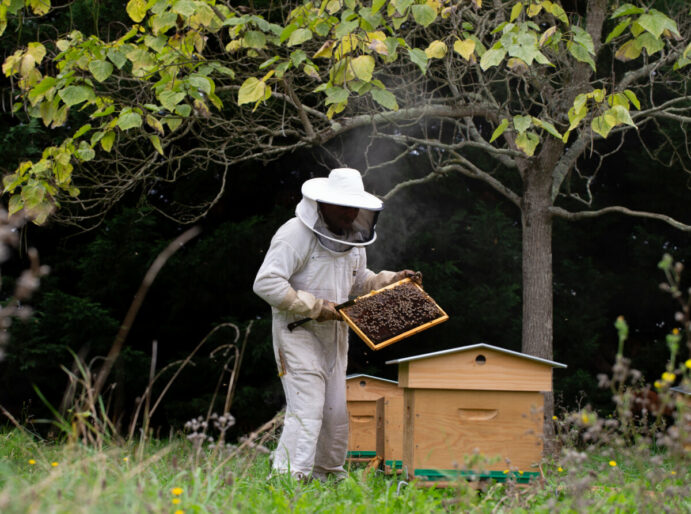
Since 2022, several beehives have been hosted on the estate, entrusted to the care of a beekeeper.
There, the bees find a protected space to forage throughout spring, drawing on the estate's floral diversity to produce several honeys through the season, each with its own distinct character. From hive to jar, the honey is harvested and extracted by hand — without excessive heating or aggressive filtering, to preserve all of its aromas and natural properties. An organic honey, true to the estate that produces it. An orchard of apple and pear trees has been quietly taking root since 2026, in the midst of this preserved Eden. And other projects are currently being explored…